


YEDOENSIS Sencha Powder - Organic Japanese Green Tea Powder (100g)
YEDOENSIS Sencha Powder - Organic Japanese Green Tea Powder (100g)
Product Details
YEDOENSIS Sencha Powder - Organic Japanese Green Tea Powder (100g)
- Japan’s Most Popular Green Tea — Sencha is made from the same fine tea leaves as gyokuro, Japan’s highest-grade green tea, but steamed and rolled immediately after harvest to preserve its bright color and fresh aroma. It’s the most commonly enjoyed tea in Japan, known for its balance of flavor and quality.
- Rich in Antioxidants and Vitamins — Naturally abundant in catechins, vitamin C, and amino acids like L-theanine, sencha supports focus, relaxation, and overall wellness. Its clean, invigorating energy makes it a refreshing and health-conscious choice.
- Organic and Sustainably Cultivated — Our sencha is grown in Shizuoka under organic and ethical farming standards that protect the soil and preserve Japan’s rich tea-making heritage. Each batch is carefully crafted to ensure purity, flavor, and sustainability.
- Crisp, Fresh, and Umami-Rich Flavor — Sencha’s vibrant green liquor delivers a taste that’s both refreshing and layered, mildly grassy with gentle sweetness and an elegant umami finish. Its flavor changes with brewing temperature, offering a new experience with each cup.
- Fresh from Shizuoka, Japan — Grown between Mt. Fuji and the Pacific Ocean, Shizuoka’s climate and mineral-rich soil produce some of Japan’s finest teas. Our sencha captures this essence of place, delivering both quality and authenticity.
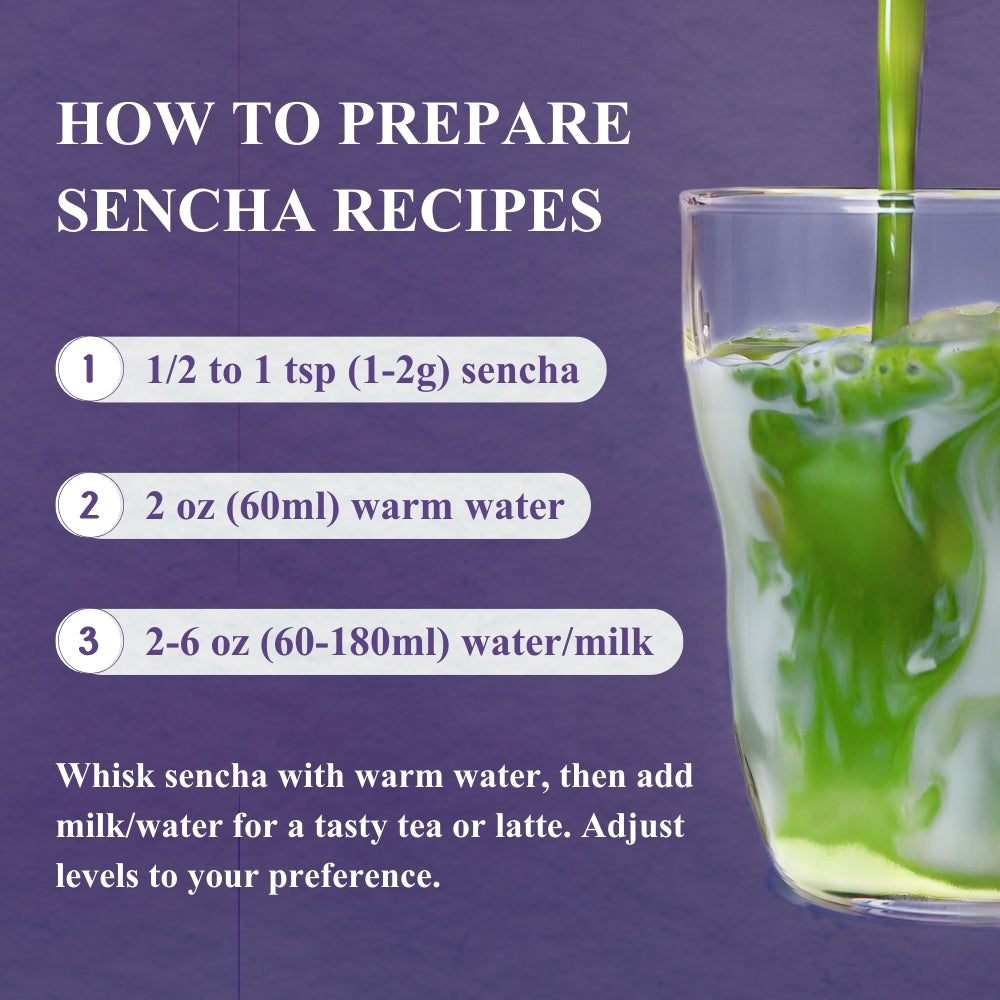
- Enjoy It Your Way — As a powder, sencha can be easily used for traditional teas, lattes, smoothies, or even in baking. Its vivid green hue and refreshing flavor make it a versatile ingredient for any tea lover.
Couldn't load pickup availability


Collapsible content
Item Details
- 3 cans/1.4oz (40g) each
- Vegan and Halal product
- Origin: Shizuoka, Japan
Shipping and Handling
We currently only have capacity to ship to the United States, Canada, and Japan. We are working hard to provide worldwide shipping options in the near future!
FAQ
1. What makes these teas traditional? These teas each have their own unique history and meanings within Japan. Matcha for example is highly prevalent in traditional ceremonies, and Genmaicha was popularized during the Edo period in Japan as tea merchants sought to extend their supplies to help get through tough financial times. Furthermore, their cultivation method is also done through traditional Japanese means, assuring an authentic and true to Japan product.
2. How should I store this product? We recommend that you store your genmaicha away from light and sealed firmly in a cool environment. Placing it in the refrigerator is best to maximize freshness.
3. What is your policy on "best by" dates? While it heavily depends, there will always be at least 3 months before the best by date. Upon opening, we do recommend that you consume all the contents within 1-2 months for the best quality.
4. The serving sizes are too small, what should I do? Japanese palettes often 1 gram per serving so this is what we used as our guideline. However, a benefit of powdered tea is that this can be altered to the level of your choosing. If you prefer a stronger taste, you can put 2-grams of the powder in your cup to experiment and see what is to your liking.
5. Are all these teas gluten free? Yes, all the teas included in the Classic Collection are gluten free.
6. Can all of them be enjoyed hot and cold? Of course! All three of our teas can be enjoyed in various different ways. Whether it be hot, cold, in a latte, or used as an ingredient in food, matcha, genmaicha, and hojicha prove to be versatile products.
7. Why does YEDOENSIS focus on powdered teas? Studies have shown that funmatsucha (Japanese powdered tea) extracts more nutrients from the leaves than standard brewing methods. Specifically, the process of applying hot water to tea leaves is said to only extract 30% of the contents in the leaves. In comparison, funmatsucha allows you to consume all the natural nutrients in the tea leaves as they are crushed in a fine powder without any leftover. This demonstrates mottainai, or the Japanese principle of "do not waste."